<?xml version="1.0" encoding="ISO-8859-1"?>
<!-- generator="RSS XML FEED CREATOR" -->
<rss version="2.0">
    <channel>
        <title>UQ Events</title>
        <description>Daily events from UQ</description>
        <link>http://www.uq.edu.au/events/</link>
        <lastBuildDate>05-07-2009</lastBuildDate>
        <generator>RSS XML FEED CREATOR</generator>
        <image>
            <url>http://www.uq.edu.au/events/images/admin-calendar-icon.gif</url>
            <title>UQ Events Logo</title>
            <link>http://www.uq.edu.au/events/</link>
            <description><![CDATA[Feed provided by UQ Events. Click to visit.]]></description>
        </image>
        <item>
            <title>Junior Physics Olympiad</title>
            <link>http://www.uq.edu.au/events/event_view.php?event_id=5394</link>
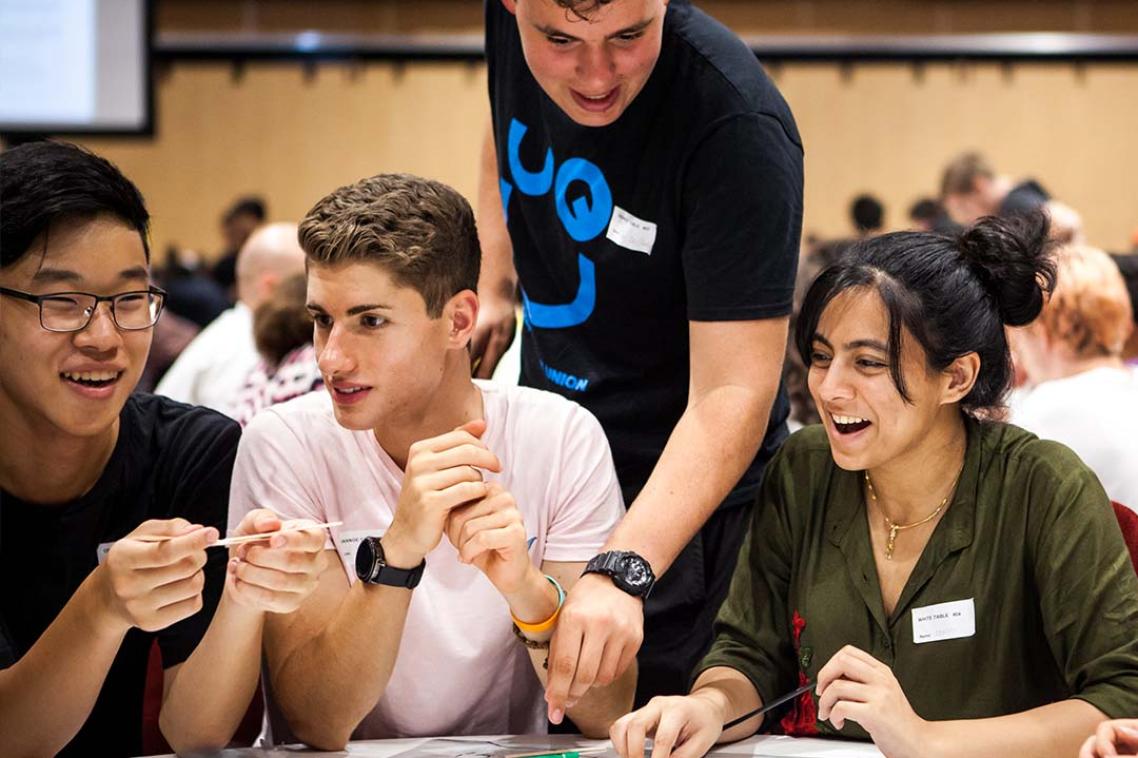
            <description><![CDATA[The 2009 Junior Physics Olympiad sees 40 exceptional year 10 and outstanding year 9 students spend 5 days participating in lectures, tutorials, experiments, hands-on workshops, lab tours and forums that teach physics, refine their problem solving skills and challenge their abilities.

In the skilled hands of the UQ Physics Demo Troupe Olympiads will be trained in the art of circus physics and entertaining workshops.

Olympians will also get to tour some of Queensland’s best research labs including the Engineering Department`s X-labs which house X-series expansion tubes that have been used to simulate a spacecraft entering different planet’s atmospheres, UQ’s Centre for Magnetic Resonance’s MRI facilities, and the Centre for Microscopy and Microanalysis’s electron microscopes that will reveal the amazing structure of the world at extremely small scales.

JPhO is not just for the students, on the Tuesday and Thursday evening parents, alumni and the general public are invited to two forums which will be held in Parnell Building.   

In celebration of the International Year of Astronomy the final day will feature a visit to the Sir Thomas Brisbane Planetarium.

The deadline for applications has been extended to the 15th of May; see www.smp.uq.edu/jpho for more information and application forms.]]></description>
            <author>UQ Events</author>
        </item>
        <item>
            <title>Junior Physics Olmpiad Public Lectures</title>
            <link>http://www.uq.edu.au/events/event_view.php?event_id=5496</link>
            <description><![CDATA[Professor Andrew White will discuss latest advances and concepts of Quantum Physics followed by ample time for the audience to ask questions and discuss.]]></description>
            <author>UQ Events</author>
            <pubDate>30-06-2009</pubDate>
        </item>
        <item>
            <title>ACPACS Seminar: The Boat Symbol of Asia and Oceania - Exploring ‘lost civilizations’ and ...</title>
            <link>http://www.uq.edu.au/events/event_view.php?event_id=5465</link>
            <description><![CDATA[Presenter: Dr Claire Rawnsley, Research Fellow ACPACS

The aim of this seminar is to situate the island of Timor, with particular reference to East Timor, in its historical, geographical and cultural context of Southeast Asia and Oceania. 

Recent archaeological research findings highlight two significant language groups, Austroasiatics and Austronesians, which appear to have originated from South China about 6000-7000 years ago. By focusing on the boat symbol which is engraved on the Dongson bronze drums and also discovered in caves throughout Southeast Asia and Oceania, I emphasize two aspects. 

The first is that both groups excelled in a sophisticated technical culture, for example, the Austroasiatics (AA) made great advances in the molding and decorating of bronze drums, whereas, the Austronesians (AN) displayed significant development in boat-building techniques and navigation skills. Not only did both groups excel in material culture but also gave vivid expression to belief conceptions as indicated by the boat symbol found on the Dongson drums and in caves, hence illuminating beliefs shared by both groups. 

Timor is closely connected to these language groups and with the accumulation of modern research it is now possible to harness findings from archaeology, anthropology and other disciplines to shed light on East Timor’s prehistory. 

Generally, histories of East Timor stress European colonial and post-colonial period, whereas, the pre-1500 era has been sparsely treated and then, only as a precursor to the modern period.  By exploring prehistory and the significance of the boat symbol as found on the Dongson bronze drums and in caves of East Timor, I argue that it is possible to find common connections and more fully appreciate the cultural heritage of East Timor.

Dr. Claire Rawnsley, PhD, is a Research Scholar at ACPACS. Her research interests include philosophy and Chinese history, the prehistory and history of Southeast Asia and Oceania, East Timor and nation-building;  and issues relating to the culture and rights of indigenous peoples.

The seminars are free, and all academics, staff, students, and interested persons are welcome. For enquiries please contact: Serge Loode, 334 68742 or acpacs@uq.edu.au.]]></description>
            <author>UQ Events</author>
            <pubDate>01-07-2009</pubDate>
        </item>
        <item>
            <title>Junior Physics Olmpiad Public Lectures</title>
            <link>http://www.uq.edu.au/events/event_view.php?event_id=5497</link>
            <description><![CDATA[A Journey into a Black hole presented by Dr Joel Gilmore.

Black holes have featured in dozens of books and movies - but what would
it actually be like to travel into one?  

Is there any truth to the science fiction? Does time really slow down?  Could we reach other universes?  What actually is a black hole? And what exactly is
spaghettification?

Come along to find out all this, and more!]]></description>
            <author>UQ Events</author>
            <pubDate>02-07-2009</pubDate>
        </item>
        <item>
            <title>HPRC School, Studies in Religion public lecture by Swami Sridharananda on `Unity of Existence ...</title>
            <link>http://www.uq.edu.au/events/event_view.php?event_id=5506</link>
            <description><![CDATA[Swami Sridharananda is an exponent of  Vedanta Philosophy. He captures his audience by his eloquence and logic and never fails to interest his listeners in the concept of the Unity of Existence and Harmony of Religions. `Being and Becoming is the core of religion,’ he states, ‘while doctrines, dogmas are but secondary details.’ This message is the theme of his talk at The University of Queensland. Swami Sridharananda is the President and Spiritual Minister of the Vedanta Centre of Sydney.

Born in 1925 in Calcutta, India, the swami graduated in Engineering from  Calcutta and joined the Ramakrishna Order in 1947. He worked at the Headquarters of the Ramakrishna Order for a few years and then was sent to work at the Order`s hospital in Rangoon, Yangon.  

Later he was posted in Patna, Varanasi and lastly Lucknow in the state of Uttar Pradesh,India. He stayed at Lucknow for 46 years during which period he built up a modern 200-bedded hospital for the treatment and care of poor patients and also built a temple for worship and silent contemplation, which is a landmark of that city now. He also regularly visited Singapore, Malaysia, Indonesia, Thailand and Germany on the invitation of various groups of devotees as also the local universities. 

He visited Australia and New Zealand in 1993 and 1997 on invitation before settling here in 2000. He is at present the President and Spiritual Minister of the Vedanta Centre of Sydney and visits Adelaide, Melbourne and Canberra once a month for talks. In Melbourne his talks are held at the Monash University.]]></description>
            <author>UQ Events</author>
            <pubDate>04-07-2009</pubDate>
        </item>
        <item>
            <title>BioFutures 2009</title>
            <link>http://www.uq.edu.au/events/event_view.php?event_id=5493</link>
            <description><![CDATA[A Biotechnology and Biomedical science forum for high school students. 60 Year 11 and 12 students will experience studying at the University of Queensland for one week. Organised and run by the Australian Biotechnology Student Association (ABSA).]]></description>
            <author>UQ Events</author>
            <pubDate>05-07-2009</pubDate>
        </item>
        <item>
            <title>FEAST Residential Camp</title>
            <link>http://www.uq.edu.au/events/event_view.php?event_id=5008</link>
            <description><![CDATA[FEAST (Future Experiences in Agriculture, Science and Technology) is a five-day residential school held at the St Lucia and Gatton campuses. 

FEAST provides course and career information sessions, tours and a practical program designed to help students understand the range of course and career options in agribusiness, agriculture, horticulture, the environment, food and animal sciences. 

FEAST will be held from the 5th – 9th July 2009. 

For more information:

p: (07) 54601 279
e: <a href="mailto:feast@uq.edu.au">feast@uq.edu.au</a>
w: <a href="http://www.uq.edu.au/nravs/feast">www.uq.edu.au/nravs/feast</a>]]></description>
            <author>UQ Events</author>
            <pubDate>05-07-2009</pubDate>
        </item>
    </channel>
</rss>